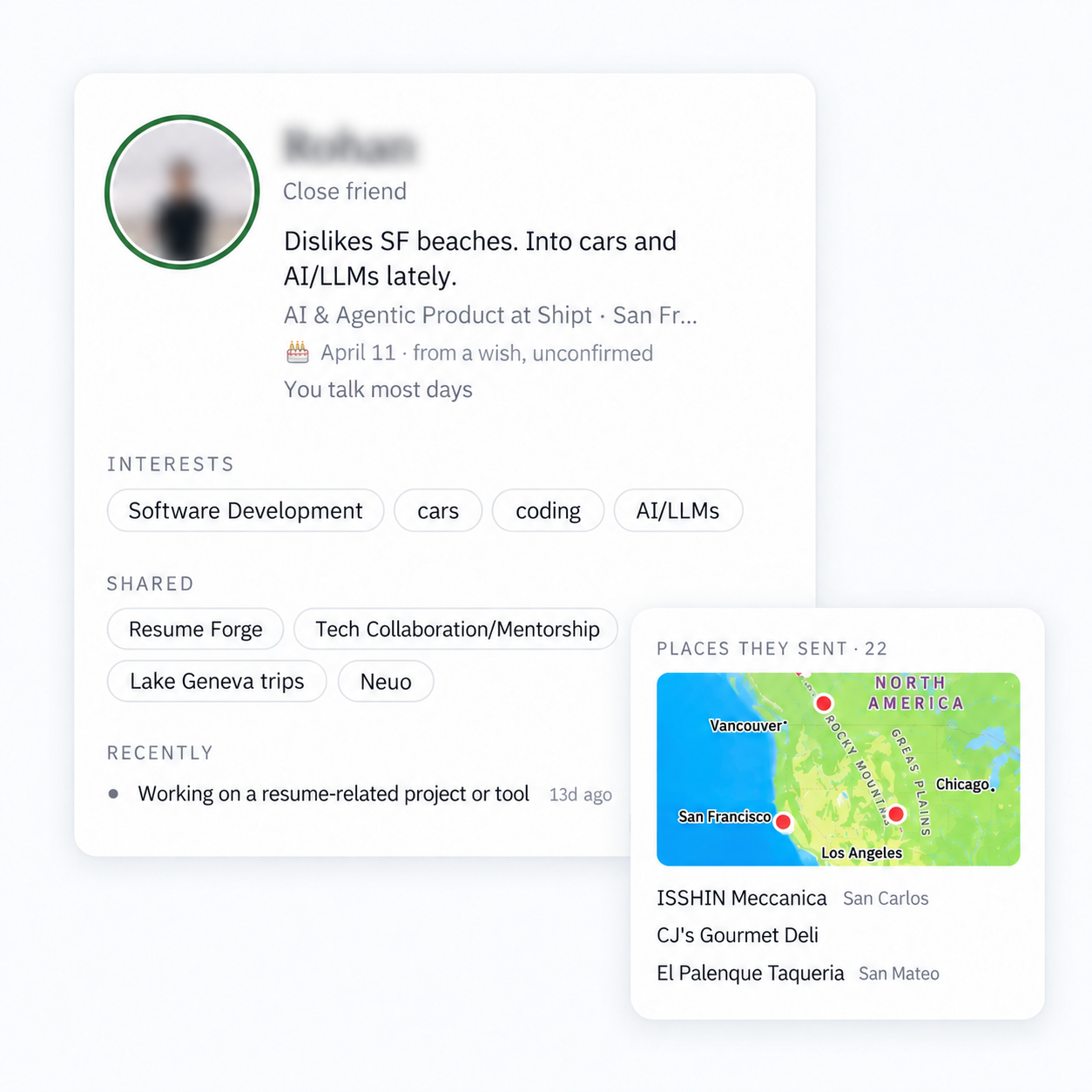
What a personal CRM is
A place to remember the people in your life — what they're up to, when you last spoke, what you promised each other — so relationships don't drift by accident. The idea is right. The tools mostly ask you to maintain a second address book by hand.
Why they die
Every personal CRM starts with a clean import and good intentions. Then it needs a note after each coffee, a tag for each person, a reminder for each follow-up. A busy month happens, the entries stop, and the tool quietly becomes wrong. A CRM you stopped feeding is worse than none: it tells you with confidence what used to be true.
You already keep the record
Years of it, in Messages. Who wished whom a happy birthday. Who asked for the restaurant name and never got it. Who moved, got engaged, started the new job, went quiet. The record exists; it just isn't organized around people.
Sanctuary reads it, on your Mac
It builds a card for each person from their own messages: relationship, what they like, what they recommended, what's going on with them, the dates that matter, how often you actually talk, and the open loops between you. Every item shows the message it came from, and you can mark it wrong. Nothing to enter, nothing to tag.
Keeping in touch, measured honestly
Instead of a reminder cadence you invented, Sanctuary learns the rhythm you actually had with someone — weekly, monthly, twice a year — and surfaces the people who have fallen well off theirs. Drifting apart stops being something you notice a year late.
The promises nobody wrote down
"I'll send you that", "let me introduce you", "I'll look at it tonight" — casual commitments, in both directions, pulled out of the thread and kept as open loops until they close. It is the follow-up list you would never have typed up.
It suggests; it never sends
Sanctuary will tell you it's been four months since Nina, that Marcus is still owed an intro, that a birthday is coming. It will draft nothing on your behalf and message no one. Reaching out stays yours.
What makes it different
A typical personal CRM — Dex, Mesh (formerly Clay) — is a cloud account fed by your email, calendar and LinkedIn, plus the notes and reminders you keep up. Sanctuary has no account and no server copy. It reads Messages, Contacts and Apple Mail on your machine, takes your LinkedIn export if you have one, and the message text never leaves. The cards are facts with a source, not profiles of people.
Ask it like a person
“Who do I know at Stripe?” “What did Roshni ask me for?” “Who did I promise to introduce?” The same questions you'd ask a good assistant, answered from your own history, with the message underneath each answer. Connect Claude and it can ask too — behind a switch you control, never the messages themselves.
How your CRM fills itself in
- Step 1
Install and grant access
The app reads the Messages and Contacts databases already on your Mac. No import, no CSV, no connecting accounts.
- Step 2
People resolve themselves
Phone numbers and emails fold into one person using your own address book, so a thread and a contact become the same human.
- Step 3
Cards fill with sourced facts
Interests, recommendations, job changes, dates and open loops are drawn from the messages — each with the line it came from.
- Step 4
Ask, or get nudged
Query anyone in plain language, or let Sanctuary flag who you've drifted from and what you still owe. Suggestions only.
Sanctuary vs a traditional personal CRM
| Sanctuary | Dex, Mesh, a spreadsheet | |
|---|---|---|
| Data entry | None — read from your own history | Notes, tags and reminders after each interaction |
| Day-one contents | Years of relationships | An imported contact list |
| Birthdays and dates | Recovered from past messages | Fields you fill in |
| Open loops and promises | A task you remembered to create | |
| Keep-in-touch cadence | Learned from your real rhythm | An interval you pick |
| Where your data lives | Your Mac | The vendor's cloud |
| Account required | None | Sign-up and sync |
| Sends messages for you | Never — suggests only | Often the selling point |
Comparison reflects how these tools are designed to be used, not a feature-by-feature audit.
Who it's for
- People with a wide circle and no system for keeping up with it
- Founders and operators who meet a lot of people and forget the details
- Anyone who realises months later that a good friendship quietly went quiet
- Former Dex, Mesh or spreadsheet users who stopped updating the spreadsheet
Common questions
What is a personal CRM?
A private system for keeping up with the people in your life — friends, family, colleagues and loose ties — rather than sales leads. It tracks who you spoke to, what matters to them, and what you meant to follow up on.
How is Sanctuary different from Dex or Mesh?
Those are cloud accounts you feed with notes, reminders and connected services. Sanctuary reads what you already have on your Mac and builds the same picture without the upkeep, with no account and no copy of your history on anyone's server.
Do I have to import my contacts?
No. Your Mac's Contacts and Messages are read in place, and handles that belong to the same person are folded together automatically.
Where do birthdays come from if I never entered them?
From the messages themselves — last year's birthday wishes in a thread are strong evidence, and the card shows you the line it inferred the date from.
Will it message people for me?
No. Sanctuary suggests and never sends. It will point out a drifting friendship or an unfinished promise; the outreach is yours to write.
Is my message history private?
Yes. Everything is read and stored on your Mac, with no account and no telemetry. Optional cloud AI runs on a key you provide, and only a link, its site and a short excerpt ever leave.
What does it cost and what do I need?
An Apple Silicon Mac. Free for 14 days without a card, then $29 a month or $275 a year.